
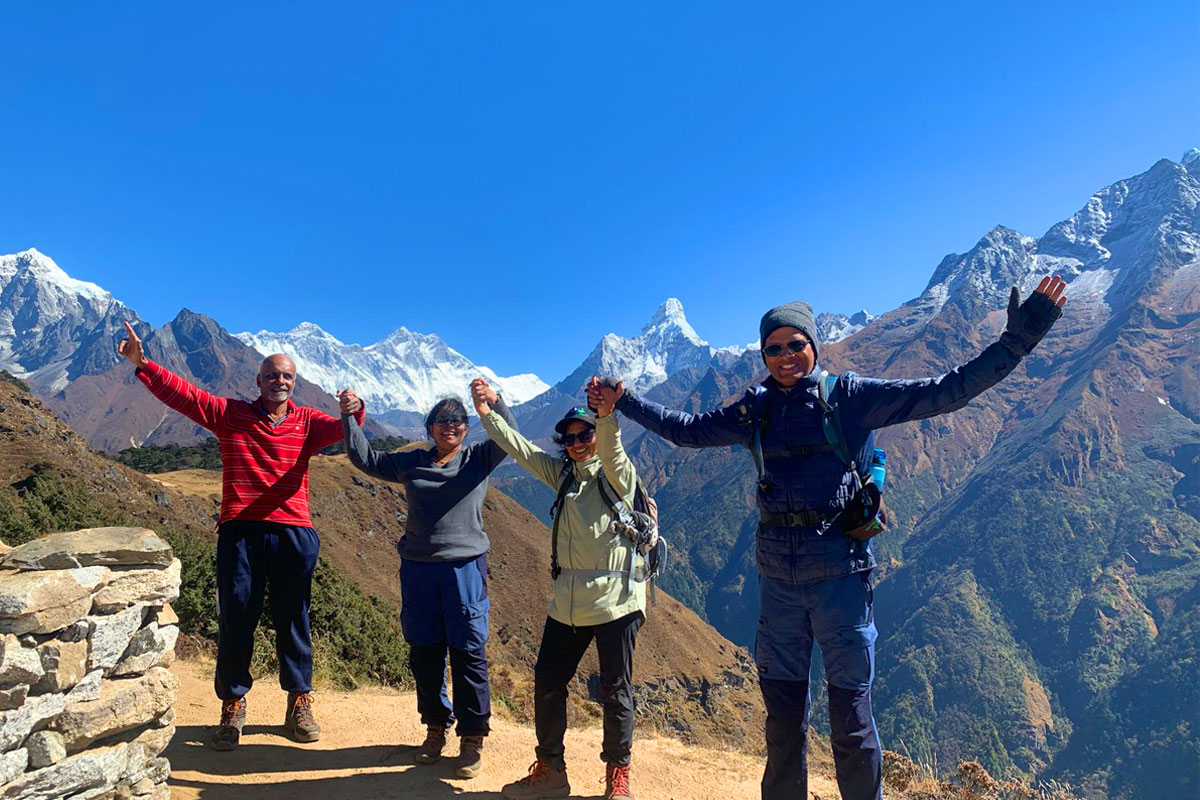
Everest Base Camp Trek is very popular around the world, and brings thousands of hikers from all over the globe to Nepal every year. The route is littered with panoramic views of epic scale, mixed with a glimpse into the very different Sherpa culture and last, but not least, the view one gets when looking directly at the foot of the highest mountain on the planet. But as you trekked across the harsh landscape, navigated up to rarified altitudes and battled the problems like rabbits, you soon realised it is a trek not only of the physical but also the mental and emotional kind.
I was indeed very, very lucky to have an amazing guide who introduced me to his personal version of the Khumbu, on the way up to Everest Base Camp. Little did I know that the plant was not supposed to reveal all his wisdom to me, just before we started our journey, but instead at the most critical junctures of our adventure – in fact, at the very end of it, on Everest Basecamp. Standing still in the moment, in awe of the beauty and magnitude of it all, here is what my guide planted into my brain, and how it would change my perspective on the journey, the people, and their mountain. Here’s what I learned.
Life’s not all about the Everest. The journey is the thing
“We had a little extension of this strange year because of all the dozens and dozens of Earths in alignment. He told me that at Everest Base Camp, while gazing at the gigantic Khumbu Icefall. Many people want to see Base Camp so they can take the traditional photo in front of Everest. I know Base Camp is where you go, but the show is happening before you even get there. From the day you fly out of Lukla to the final time some part of your hiking boot touches land at top Base Camp Treks, every step, person, and obstacle adds up to solidifying a four-week-long adventure into the most unforgettable memory imaginable.
As Itahisa says, “When you walk and take the same route as religious festivals, the journey is as important as reaching the destination (laughs while crying)”.
Your Biggest Enemy Will Be Altitude, Your Biggest Ally Your Mind
You can read all about the symptoms of altitude sickness, but it feels a lot different in practice. I knew altitude sickness could come out of nowhere, and when it came, I didn’t quite expect it to hit me so physically and mentally. I felt fatigued, had headaches, and I vomited at higher altitudes.
When I told my guide about these symptoms, he noddedat me and said, “You have to tough it out mentally as much as physically to climb altitude”. Your physical will go down, but you have to keep your head up, and well, that’s the fourth quarter of the game for us right there,” he said. One foot in front of the other is all you can do.
It was then that I learned that travel is all about attitude. If you want to get to the starting line, you have to be fit; if you want to get to Base Camp, you have to have the right attitude.
Sherpas are Mountain Guides, but They Are the Guardians of Everest too.
I knew Sherpas were good at trekking at altitude, and that they were integral to the operation of the mountains, but I didn’t realise the extent until I got to Base Camp. My guide explained to me that the Sherpas’ relationship with Everest is spiritual. For those trekkers, it’s a service to lead them to Base Camp, but also a life of hard work that they have committed to on behalf of the mountain and its ecology.
Everest is like a church for Sherpas, and so is walking there. Sherpas use Everest, one of the many peaks, and some of them make offerings, or do other prayers, praying for all blessings at the start of the season. This is why the Sherpas are not only guides but also protectors of the mountain, who make sure that not only will you reach Base Camp, but do so with respect and safely.
There’s Purpose in Every Step of This Hike
‘There was a point in the trail where we were going up to Lobuche: (I thought) “you little shit”. It was a steep trail, and it was cold out there, and I was very tired. And my guide saw that I was struggling,g and he said to me, “Well, you are not just hiking here, you are actually walking with a purpose. This is about stretching yourself, discovering yourself, and preparing for the next thing in life. It’s a mantra for performing arts.”
I didn’t really understand what he was talking about until I got to the top. Each struggle, each aching physical and mental journey, prepared me: this is how I grew stronger. By the time I got to Everest Base Camp, not only was I physically stronger — I felt mentally sharper and had a clearer picture of what it is that I am really capable of.
The Weather Here Doesn’t Play by Your Rules.
This one got to me. I felt so well prepared; I had even checked the weather so that my hike could happen during the best possible weather. But as we started hiking, I quickly realised the weather in the Khumbu region is unpredictable. Sudden snowstorms, strong winds and high temperature variations are a common occurrence.
‘Weather has its own mind,’ My guide told me. You don’t get any sense of planning down.” You sort of have to game-plan on the run and deal with that,” he said. But the weather’s the least of it; if you are following your dream of hiking your ultimate hike, then the weather is one of the hardest things to plan for. And whether it be snow, fog, or sun, you will acclimate to the change in conditions and make the most of your trip.
You Will Find Out So Much in a Few Days that You Haven’t in a Few Years
I didn’t expect that, but when we got to Base Camp, my guide came up to me and said, “This mountain, this walk, is going to be the best thing to teach you about yourself. “Up here, when you are confronted with hard conditions, physical and mental obstacles, you will see yourself in action.
And he was right. The experience challenged me to overcome fears, smash through my perceived physical abilities and what I thought I could do. I was learning about my abilities every day in the forest: my strengths, my weaknesses and how to overcome them all. It was a transformative experience.
Slow and Steady: The Best Way to Go
I was living by the mantra “slow and steady wins the race” during the trip, but couldn’t understand the life-affirming power of it until we were well up the mountain. My guide was adamant that we stop and rest and then “listen” to when it would be time to get going again.
“At this altitude, it’s not a question of speed,” he said. “It’s about listening to your body and the speed at which you should walk.” This was good advice. It was not only a good idea to slow down and listen to my body to avoid altitude sickness, but it was also more fun.
Everest Is the Boss. You’re Just a Visitor
We were standing at the summit, and my guide was gazing out at Everest spreading out before us, and he said, “Everest is the boss. You’re just a visitor. You respect the mountain, the mountain will respect you”.
It was a humble lesson in how, as much as we practise and concentrate and try to control the experience, sometimes it just comes down to nature! We are all visitors in the Kingdom of the Big Man, and we need to be humble.
Conclusion
The journey to the Everest Base Camp is not just a physically arduous endeavour. (It was a way that I’d soon found, my guide informed me, that it’s a spiritual and emotional and mental journey in which you encounter yourself: your limitations, yes (some of which are familiar to all of us) but otherwise stuff about yourself you’ve never had an inkling even existed.) It’s not the view from the bottom of the world’s highest mountain; it’s what happens to you (mentally, physically) as you approach it. So when you take this incredible journey, be prepared for an emotional one. It is always worth the physical and psychic burden that comes with it – and as my guide so eloquently stated: Enjoy the journey.